A string of “wins on paper” threaded through personal and business turmoil, with a steep rise in caregiving responsibilities, was harder to talk about in public than overseas travel, new content, or product and promo videos.
Professionally, 2025 started out looking steady from the outset: interviews, webinars, integrations, attending ICANN Seattle, and generating thought pieces about registry strategy, DNS abuse, and brand protection that kept me active in the usual corners of the industry.
Shadowing that as the year progressed was a quieter reshaping of my work identity, eventually stepping out of my role at NameBlock in October after three years, and trying to build a consulting pipeline while navigating the emotional drag that comes with instability.
The business side of 2025 for me was less about big deals and more about endurance: trying to stay visible, staying useful, and staying just persistent enough not to disappear without being able to attend any industry events between late March and early October.
What did not show up in my social posts, until this year-end reflection, is how dramatically family-health and caregiving-related responsibilities increased this year. As my father’s health declined, my personal calendar quietly filled with appointments, logistics, and difficult conversations, all layered on top of work, that, on social media, still looked relatively normal.
In late August, that caregiving chapter came to an end with my father’s passing. Grief does not respect project timelines, business challenges, or content schedules, and the weeks around that time were less about any sense of “balance” and more about simply holding things together for the people who needed it most. If 2025 had a single defining thread, it was learning how thin a person can be stretched between professional obligations and family duties, and still try to show up with some semblance of grace.
If 2025 teaches anything, it is how wide the gap can be between what shows up in a feed and what life actually feels like.
There is a temptation, at the end of a hard year like this one, to wrap everything in optimism and declare 2026 will be “the big reset.”
2025 does not lend itself to that narrative for me.
Many of this year’s realities will follow into early 2026: a consulting practice that still needs tending, a domain industry that is as noisy and competitive as ever, and a family life that now includes the quieter work of healing and making sure my surviving parent is comfortable. For now, looking forward feels less like a bold prediction and more like a modest intention: to keep showing up, to keep contributing where my experience is useful and impactful, and to be a bit more honest about the parts of my story that rarely make it into the social conversation.
I’ve said this so many times over the years: If you told me on January 1st that such and such would happen before the year’s end, I’d tell you that you are nuts. Well, every year, such and such happens. Sometimes really good, and sometimes really bad. This year definitely had a mix of both.
I did not intend for this to be a “Debbie Downer” review of 2025. It’s not my true nature. However, this isn’t the neat, upbeat year-end recap I thought I would write. 2025 was a mix of progress, loss, and a few too many hard lessons.
For now, it’s enough to say: I’m still here, I’m still standing, and hope springs eternal.
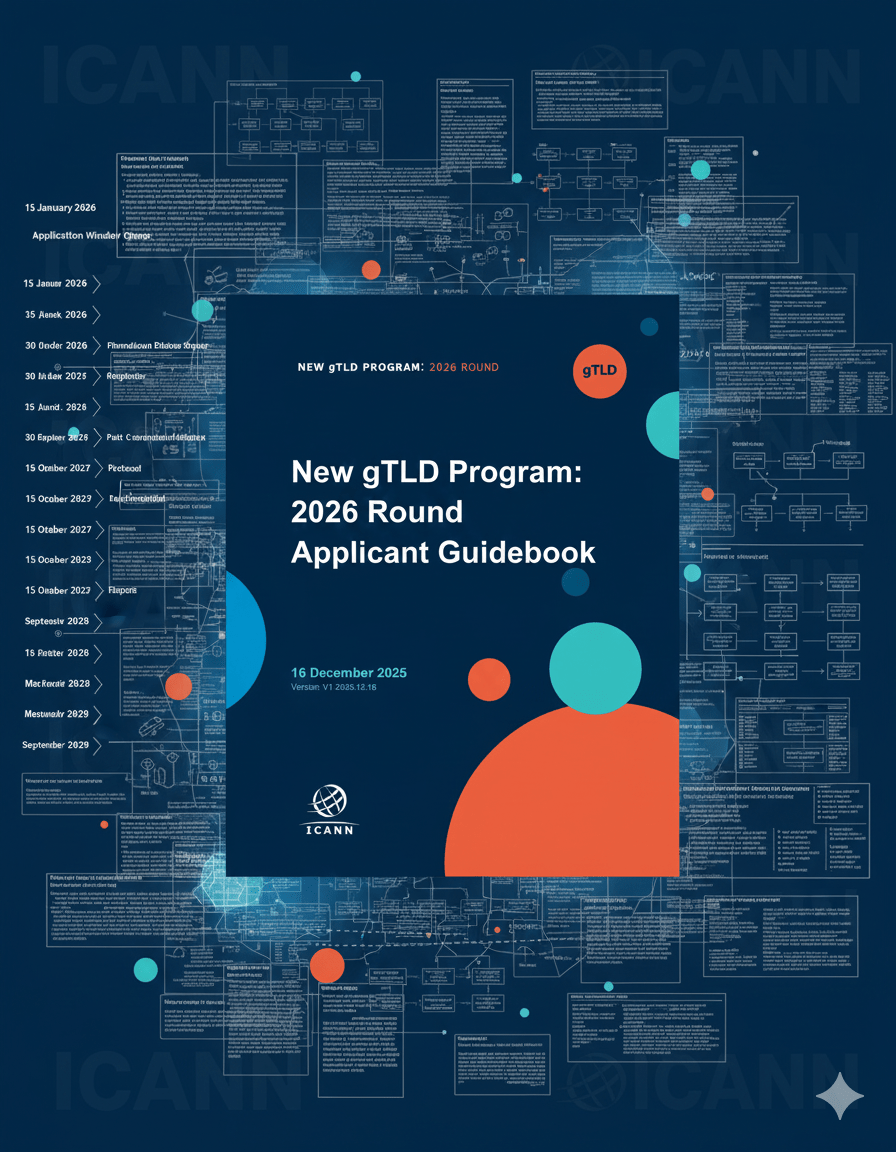
The new gTLD program 2026 Round Applicant Guidebook (“AGB”) is now final and has just been published by ICANN. The next round is no longer hypothetical; it’s a dated, documented, and rule-dense reality. For some organizations, this is a once‑in‑a‑generation opportunity; for others, it may quietly become an expensive, multi‑year distraction.
Should you still apply?
Yes, if you are clear-eyed about the trade-offs.
The 2026 AGB gives far more predictability than 2012, but also much less room to improvise. It locks in the 227,000 USD evaluation fee per application, defines how and when refunds might apply, and walks you through a long journey of evaluation, objections, potential contention, contracting, and years of compliance.
For serious applicants, there are real opportunities in this round:
The revamped Applicant Support Program can lower entry costs and provide training and pro bono help if you genuinely qualify and can operate what you are asking for. (Note that the application submission period for this closes on 19 December 2025)
The RSP Evaluation Program means you can plug into pre‑evaluated back‑end providers rather than building and defending your own registry stack from scratch.
Replacement strings and a clearer contention framework give you more structured strategic options than in 2012, if you plan them early and understand the limits and timelines.
The expanded GAC, community input, objections, and appeals machinery can become a moat for well‑designed public‑interest or community models, not just a source of friction.
There are also very real risks, especially for non‑portfolio players:
Under‑estimating total cost: the 227k fee is just the start, once you add legal, RSP, potential objections/appeals costs, and three to five years of operating runway under the Base Registry Agreement.
Misreading contention and replacement rules: Treating replacement strings as a late‑stage escape hatch, or under‑estimating the cost and duration of ICANN‑run contention resolution, could lock you into a multi‑year, capital‑intensive deadlock.
Treating GAC and community processes as an afterthought: It might only take one Early Warning, poorly drafted RVC, or misaligned policy to derail all that internal work and force painful application changes.
Just as important: it is no longer enough for you and/or potential investors to “like the string.” The AGB bakes financial and operational scrutiny into the process, and the market will add its own verdict later! (There are more than a few applicants from the last round that can probably say, “I’ve been there, done that, and I still have the launch swag t-shirts!”)
So, I suggest pressure‑testing your business case against conservative revenue projections, not optimistic registration curves from launch press releases.
By all means, validate your demand. Model downside scenarios, slow adoption, serious objection, drawn‑out contention, and ask whether your organization can stomach a level of cash burn and distraction.
The applicants who will regret this round are the ones who see the Guidebook as paperwork their vendors “handle” while they focus on the string and the logo. The ones who will be glad they applied are those who treat the AGB as it now reads: a dense but navigable manual for building a durable registry business in a more scrutinized, less forgiving ecosystem.
If you are looking at the new Guidebook and thinking, “I am not even sure what I don’t know yet,” that is exactly the right instinct to explore before you commit. A trusted, independent guide and/or organization that has lived through past rounds can help you surface the blind spots on policy, contention, and, most importantly, the business model, so you can decide whether this is truly your round, or whether it is smarter to sit this one out.
Over the years, a recurring theme in conversations with registries, registrars, and brand owners has been the growing friction between essential security controls and the everyday need to keep legitimate domains reachable. False positives in blocklists can disrupt email, ecommerce, and customer trust just as surely as abuse can, which is why approaches that improve signal quality for security teams are so important.
The solution is not better cleanup; it is prevention.
That is why I am allocating some of my consulting time to support Reputable Domains, a human‑verified whitelist platform focused on reducing the likelihood that good domains are incorrectly flagged. The goal is to provide curated, verified brand data that helps cybersecurity teams distinguish legitimate domains from bad actors before problems escalate, which aligns well with the kinds of practical, data‑driven solutions the industry needs.
The Reputable Domains team published an informative and detailed announcement about the service yesterday. No matter where your organization fits in the abuse reporting ecosystem (producer, receiver, or brand), I suggest you give it a read. Then, if you want to learn more, feel free to reach out to me.
The next round is coming! The next round is coming! The. Next. Round. Is. Coming.
OK then. Are you one of the non–“portfolio player” hopefuls thinking of sending ICANN your application funds for a single TLD (or two) and hoping to survive past a possible auction? Do you believe running your own registry is the best way to make money in the domain name industry other than investing in generic, one‑word .com names?
Congratulations.
Are you sure you want to do this?
Have you run a completely independent string and financial modeling analysis outside of your own bubble? I can’t imagine you haven’t. But if not, reach out. I’m here. Full disclosure: I’m not applying for a TLD, nor am I investing in one with anyone else.
That’s the commercial. Now, on to the meat.
Let’s say you’ve jumped through all the hoops and your ultra‑fantastic TLD string is going to be delegated by ICANN. Colleagues with deep, long‑term operational and management experience in the domain industry will tell you there is no way you will be successful unless you get wide distribution through the registrar channel.
Is that true?
That has certainly been the prevailing wisdom. And if that’s the route you plan to take, then my number one piece of advice is:
SECURE SIGNIFICANT CAPITAL AND PATIENT INVESTORS. THEN DOUBLE—NO—TRIPLE THAT AMOUNT. AND THEN ADD A FEW MORE YEARS OF PATIENCE.
Don’t agree? Then go ahead and approach some major registrar players and see how much it will cost just to get on their online shelf, above the fold in search results, etc., for a few weeks, months, or quarters—or for a one‑year commitment. See how things go when you are up against dozens of other ultra‑fantastic new TLD strings trying to get in the door at MegaGiantRegistrar Inc. or SmallRegistrarWithNoResources LLC. Will you be able to compete against a well‑capitalized operator selling domains for 99 cents—or even for free?
Side tip: If the backend RSP you plan to use (or your own, if approved by ICANN) is not already integrated with registrars, then good luck. Strongly consider an experienced ICANN‑approved RSP with deep registrar connections, experience, and influence.
Money talks—marketing, placement, and dev‑support money. But even then, any registrar you work with will look at the opportunity cost of placing your TLD in their registration flow versus what your competitors will offer them. They will also consider which existing product or TLD has to come out of the flow and be replaced with yours, without confusing arriving potential customers so much that they abandon the cart and buy nothing.
If you don’t think you can secure a lot of capital until you hit certain milestones (like delegation), then I suggest you and your investors need to be open to new ways of being successful without depending on registrars as the primary means of discovery and use for your TLD.
Treat “registrar-only” distribution as just one tool—not the whole strategy. The operators who survive the next wave will be the ones who own their demand funnel, not just their registry back end.
Here are three high‑level suggestions:
Build a vertical, app‑first use case where the domain is invisible plumbing.
Bridge DNS and Web3‑style identity/liquidity so your TLD rides on entirely different distribution rails.
Create a multi‑stakeholder commercial alliance (platforms, SaaS, telcos, devices) that bakes your TLD into existing high‑traffic ecosystems.
Let’s unpack those a bit more.
1. App‑first “embedded domains” instead of registrar sales
The shift here is to stop thinking “sell domains” and instead “sell outcomes where a domain is bundled and invisible.”
Build or partner on a vertical SaaS/app (e.g., booking, creator pages, professional identity, SMB storefronts) where every new account automatically gets a domain on your TLD, with DNS and basic content preconfigured. The user never sees EPP, auth codes, or traditional registrar UX.
Technically, you still use registrars for compliance, but commercially they become back‑end pipes. You control UX, branding, and lifecycle in your own app and use one or a few wholesale registrars purely as infrastructure, similar to how some ccTLDs or larger SaaS‑led TLDs operate today.
Differentiate your TLD around that outcome (e.g., “instant verified practitioner pages,” “trusted supplier catalogs,” “auto‑local business identity”), not around the string itself. Measure success in activated live sites or connected profiles, not just DUMs.
This model breaks the crowding problem: users discover your TLD inside a solution they already need, not from a registrar search page listing hundreds of new strings side by side.
2. DNS–Web3 identity and liquidity rails
A second direction is to deliberately design the TLD as a hybrid Web2/Web3 naming and identity layer, plugging into crypto wallets, token markets, and ENS‑style resolution rather than fighting for the same registrar shelf space.
Work with ENS‑style resolvers and tokenization protocols so each domain corresponds to a transferable on‑chain token, enabling wallet‑based ownership, secondary markets, and programmable permissions while still resolving in the “normal” DNS.
Position the TLD as a canonical namespace for a specific high‑value sector (e.g., blockchain infrastructure, credentials, AI agents, IoT endpoints), where on‑chain features like verifiable ownership, signing, or payments actually matter. That can give you distribution via wallets, dApps, and exchanges instead of classic registrars.
Structure pricing and rights so that ecosystem partners (protocols, marketplaces, dev tools) share upside from primary and secondary activity, aligning them to promote your namespace as their default identity primitive.
If executed cleanly, the registrar channel becomes optional: power users acquire, manage, and trade names entirely through Web3 interfaces while the DNS side gives them universal reachability on today’s internet.
3. Alliance‑based default naming in big platforms
A third path is to skip the fragmented retail registrar channel altogether by making your TLD the default naming layer inside a few large‑scale platforms.
Target high‑volume “account‑creating” platforms (hosting/CDN, low‑code site builders, CRM/marketing SaaS, POS vendors, telcos/ISPs, device makers) and create a commercial and technical package where every new tenant gets a subdomain that can be frictionlessly upgraded to a second‑level domain on your TLD.
Offer these partners a radically simpler economic and operational model than the traditional registry–registrar stack: predictable flat pricing, revenue share or SaaS‑like bundles, APIs tuned for bulk lifecycle operations, and possibly co‑branding of the TLD as part of their product story.
Combine this with selective participation in the ICANN channel (one or two “strategic” registrars for compliance and niche retail) while treating the alliance distribution as the primary business engine rather than an add‑on.
None of these paths are easy, cheap, or risk‑free. But if your entire business case depends on registrars discovering, prioritizing, and evangelizing your new string for you, you are effectively outsourcing your fate.
If you’re seriously considering an application in the next round and want a brutally honest second opinion on your model, reach out and share a draft of your thinking. I’m happy to pressure‑test your assumptions—before ICANN, investors, and the market do it for you.
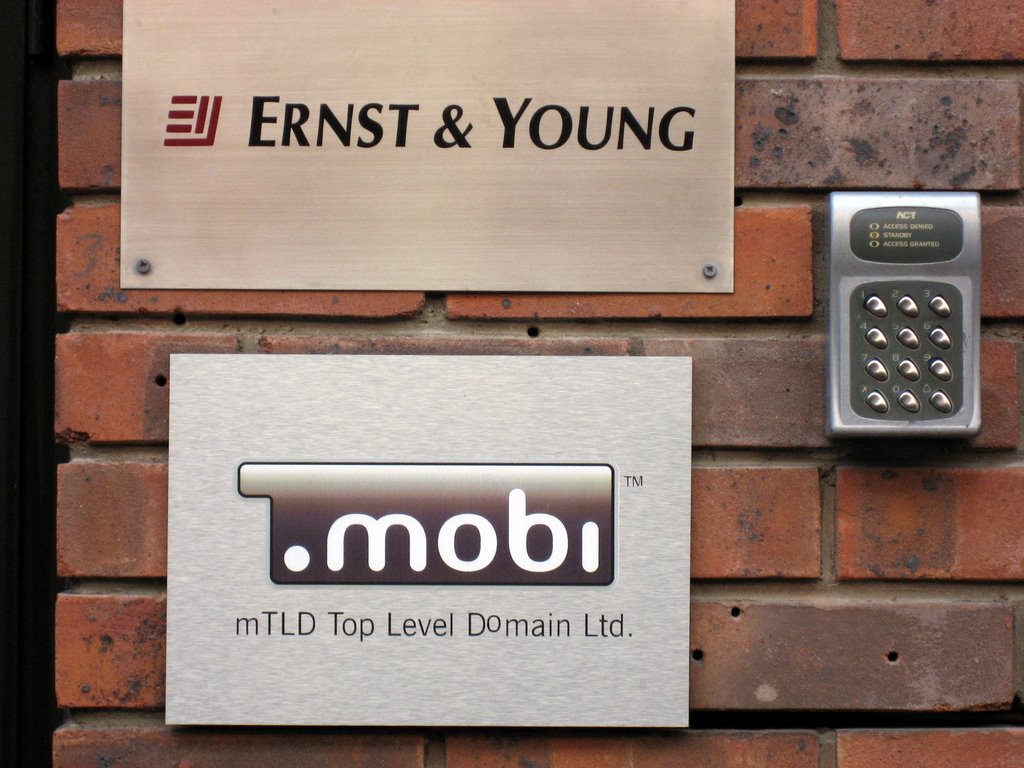
I was fortunate to live and work in and around Dublin, Ireland, for five years, first as head of Global Sales for .mobi, and later while starting my own consulting practice. Remember that TLD before the iPhone came out? Good times. 🙂
The 2006 era dotMobi office in Dublin, Ireland. (Photo by Pinky Brand)
During my time in Ireland, I met my Irish wife, and over the years, we’ve spent a great deal of time together on the island, traveling all around the country. In many ways, it’s become my second home.
One of the things I love most about Ireland is its overall vibe. There’s just something about the people, the landscape, the history, the food, the pub scene, and yes, even the weather, that always makes me want to return—maybe even to move back someday!
In the meantime, I want to share a few of my favorite Dublin-area pubs with those attending ICANN84 later this month, for anyone interested in enjoying a refreshing beverage (or two). Most of these are classics in my view: pubs that have truly stood the test of time and are well worth visiting if you have time beyond your ICANN-related business. I realize there may be newer spots—perhaps more geared toward younger crowds—that I might not know about, so please do share any discoveries with me!
For now, here’s my list:
DUBLIN CITY CENTRE AREA PUBS: These are some classic pubs for a pint or a coffee/tea in the city centre. They aren’t loud disco bars or trendy venues—just tried-and-true spots that have endured over the years. All are located south of the River Liffey.
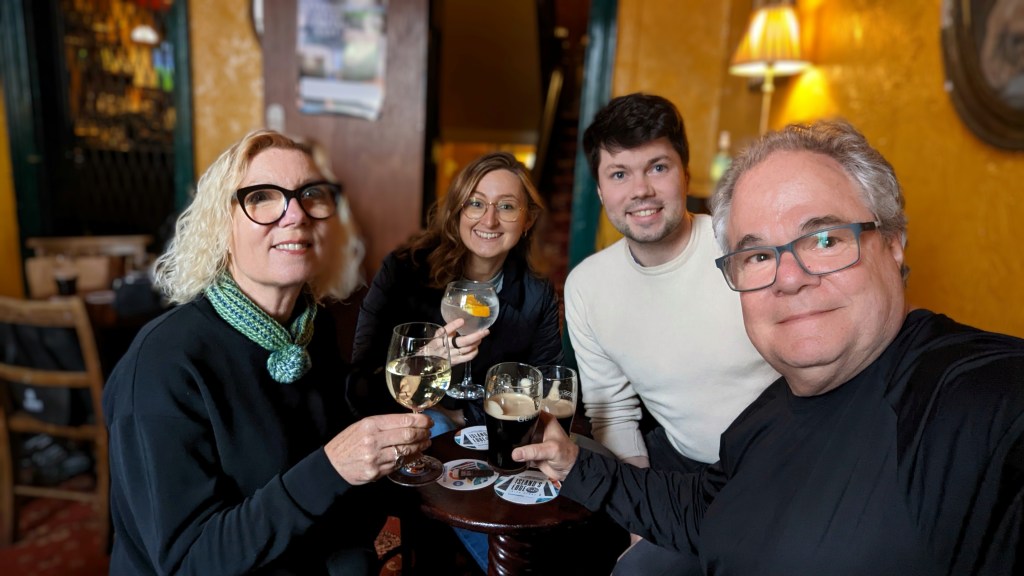
Kehoes– 9 South Ann Street, Dublin 2 – Located just down from the Westbury Hotel, Kehoes is one of my all-time favourite pubs. It’s wonderfully old and creaky, featuring mahogany bars and classic Victorian “snugs”—some of which are tucked away and a bit hidden. They’re perfect for enjoying a pint and some conversation. I personally prefer the cosy upstairs room with the fireplace. This is where I used to start most of my nights out in Dublin. On bright May and June evenings, crowds spill out onto the street and the pub gets packed—that’s part of what gives it such a special atmosphere.
Upstairs at Kehoes in Dublin, Ireland. It’s quieter, and there’s a separate serving bar that’s usually less busy than downstairs. (Photo by Pinky Brand)
McDaids – 3 Harry St, Dublin, D02 NC42 – Just out the door from the Westbury Hotel and down the street from Kehoes, McDaids is a true Dublin classic. Inside, you’ll find Victorian details, stained glass, dark wood, and plenty of history—famous writers like James Joyce once frequented this place, and it was even the Dublin City Morgue at one point! There’s no frills or fuss here, and no website either. It’s a wonderful spot for conversation and local gossip. If you’re up for scaling the steep stairs, the upstairs area is usually quieter—a perfect place to meet some local characters.
UPDATE 23 OCT:O’Donahue’s – 15 Merrion Row – How did I forget this place in my earlier post? It’s just a few steps from the Shelbourne Hotel and St. Stephen’s Green, and honestly, it’s one of Dublin’s best spots for live “trad” music every single night. The Dubliners actually got their start here! The old bar has great character, but when the weather’s nice, I’d much rather grab a pint out in the courtyard and take in the atmosphere.
The Palace Bar – No.21 Fleet Street, Dublin 2 – One of Dublin’s oldest pubs (est. 1823), The Palace Bar stands on the edge of the Temple Bar district. It’s a fantastic meeting point to kick off a night in Temple Bar. There’s no pretentiousness—just a great literary pub with a welcoming vibe. It’s also a classic spot to watch rugby, hurling, or any Irish sport. I especially like the area at the back on the first floor. Over the years, I’ve spent many enjoyable hours here with friends and colleagues, including the domain industry crowd, listening to Irish music over a pint
The Stag’s Head– 1 Dame Ct, Dublin, D02 – A few blocks west of Grafton Street, The Stag’s Head is another wonderful old-world pub serving food and hosting traditional live music. It’s smack in the centre of several other lively pubs and restaurants, making it an excellent spot to explore Dublin nightlife.
The Long Hall – 51 South Great George’s Street, Dublin 2 – A true Victorian classic, The Long Hall offers a calm spot most nights. I especially love dropping in here on a cold, dark winter day for a pint and some good conversation. There are very few places left in the world with this genuine atmosphere.
View from our table at The Long Hall in Dublin, Ireland (Photo by Pinky Brand)
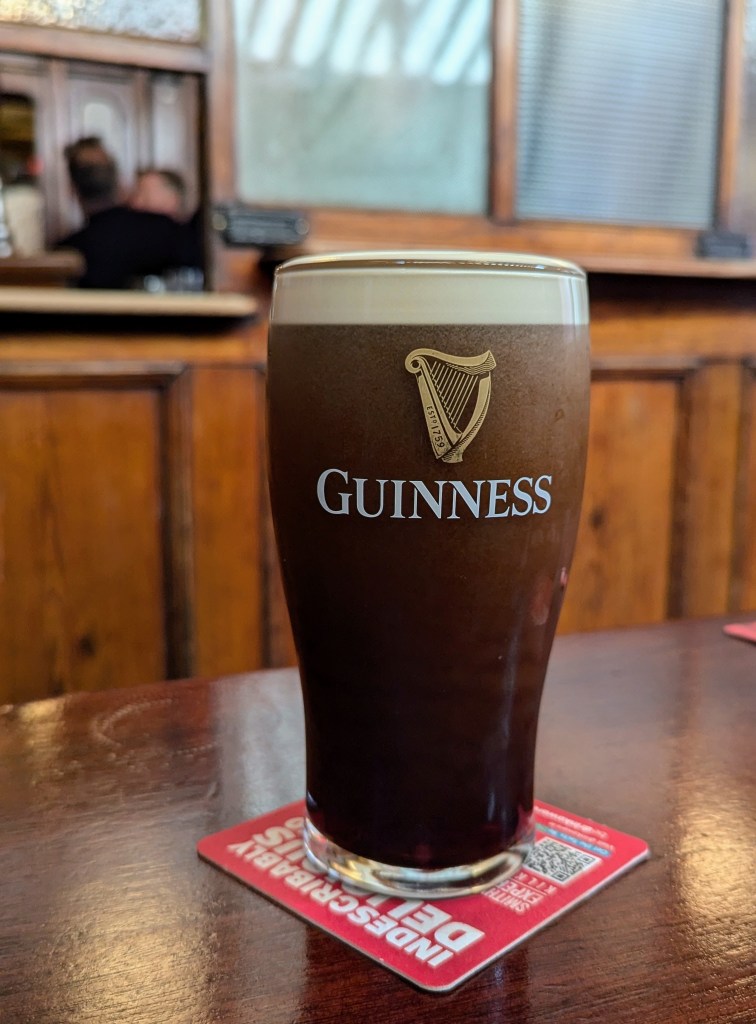
Toners – 139 Lower Baggot Street, Dublin 2 – Old, iconic, and close to The Merrion Hotel. You’ll get a great pint of Guinness here. Films shot here. It can be relatively quiet with the after-work government-types crowd, or definitely a bit rowdy on match days with locals.
TEMPLE BAR DISTRICT PUBS:
Temple Bar is a tourist-friendly area filled with pubs, restaurants, shops, cafes, and galleries along its narrow, cobblestone streets. While it’s a lot of fun for first-time visitors, be aware that things can get rowdy, especially at night, with plenty of revelers wandering about.
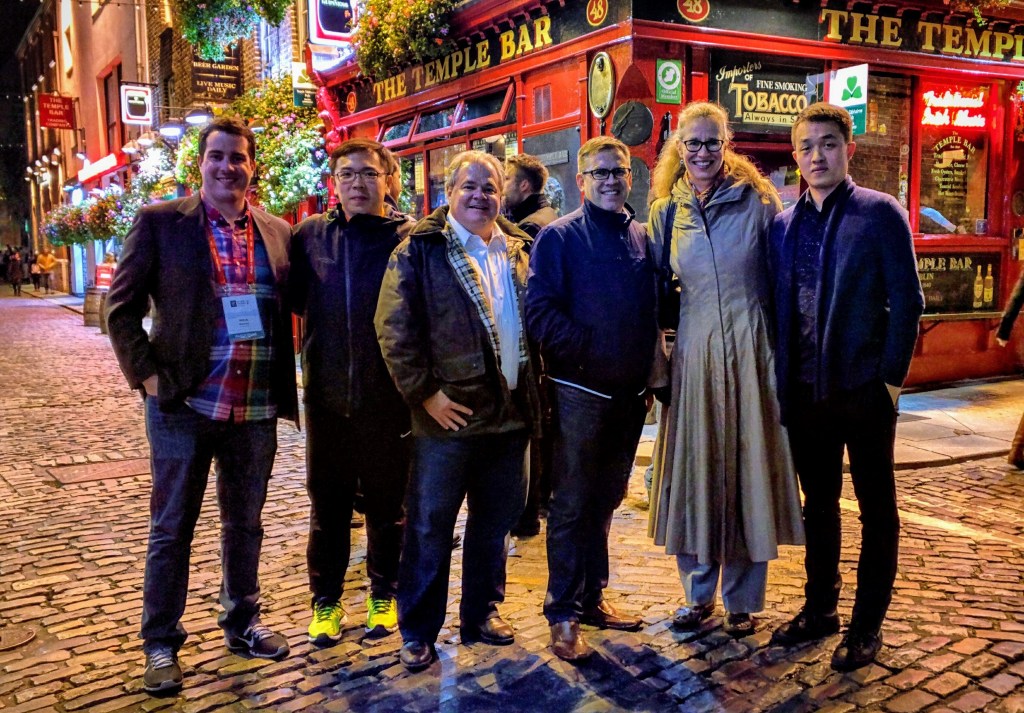
The Temple Bar – 47-48, Temple Bar, Dublin – Despite the name, this is an actual pub—not just the name of the neighborhood! The Temple Bar pub has been serving pints for over 185 years and sits at the heart of the district. It attracts visitors from all over the world, so it’s a popular spot for that quintessential “group in front of the pub” Dublin Instagram photo, like the one of us below! You’ll hear a variety of languages and find a few locals in the mix. There’s a massive whiskey selection—reportedly the largest in Ireland—and the oysters are highly recommended. It can be loud and lively, with live music and plenty of tipsy revelers. You’ve got to visit at least once (maybe twice).
Ten years ago (October 2015) at ICANN54 with TLD Registry staff in front of The Temple Bar, Dublin, Ireland
Oliver St. John Gogarty – 2 Fleet St, Temple Bar, Dublin – You might see ads for this pub at the airport or even in your hotel’s guidebook. You can’t miss it: the building is brightly coloured and well-lit. Yes, it’s touristy, but I’ve still had several genuinely fun nights here with domain industry friends. There’s always quality live traditional music upstairs, making it a great spot for a drink and even a dance. The pub also runs a B&B and hostel—though, if you stay there, don’t count on getting much sleep!
Porterhouse Temple Bar – 16-18 Parliament St, Temple Bar, Dublin 2 – Known for its broad selection of craft beers, including ales, lagers, and stouts. There’s live music every night, and weekends are often packed. The place is multi-level, so if you see an open table, grab it fast! There are other Porterhouse locations around Ireland, but this original Temple Bar spot is my favourite.
TheBrazen Head – 20 Lower Bridge St. Usher’s Quay, Dublin – Ireland’s oldest pub, continuously serving since 1198. It’s a fun spot for longer drinking sessions and live music, a little further from the main Temple Bar area on foot—but absolutely worth the visit for first-timers.
I could go on and on, especially about hidden spots farther from the city centre and in towns all around Ireland. You’ll have to catch me in person at ICANN84 if you want those secrets! And if you’d like to talk business, secure a meeting with me during ICANN84 in Dublin by booking here.
UPDATE 17 OCT: Longtime ICANN regular Michele Neylon has posted some helpful and practical tips for people coming to the meeting in Dublin here.
UPDATE 21 OCT: Please note that many of the historic and heritage pubs on my list (and others not listed) remain largely inaccessible to those with disabilities, especially establishments with narrow entrances, steps, or stairs. These venues are generally exempt from making major structural modifications. If you have difficulty climbing stairs, you will likely need to stay on the ground floor—assuming, of course, you can get through the entrance.
Also, be aware that Dublin’s early Halloween festivities begin this weekend and will ramp up next week with various events, parades, and themed nights in some pubs. The Temple Bar District will be especially lively, so The Palace Bar and the Brazen Head—located on the edges of the district—may be good options if you want to experience a bit of the area without getting caught in the thick of the crowds. And with the marathon taking place this Sunday, expect the pubs to be especially popular afterwards!
Wishing you a successful meeting and a fantastic time in Dublin!
Sláinte!
In the front snug at Kehoes in Dublin, Ireland (Photo by Pinky Brand)
Big thanks to Kelly Hardy for the great chat about China and for sharing our conversation on her Substack. It means a lot coming from someone who’s seen so much in the industry!
MarkMonitor has been around almost as long as I’ve been in the domain name industry—over 25 years! My respect for them goes back to the early days when we were direct competitors, and it has only grown as they’ve become a trusted partner supporting NameBlock.
Shane Layman, Manager of Global Industry Relations, recently sat down with me and my colleague Jeanette Eriksson, SVP of Product & Policy at NameBlock, to discuss the evolution of domain blocking and its role as a powerful brand protection strategy.
With seamless integration through the NameBlock AbuseShield API, your registrar can unlock new revenue opportunities while giving registrants real protection against impersonation threats. Offered at the point of registration or renewal, AbuseShield adds immediate, visible value—without cutting into your standard or premium domain sales.
I created a short video to demonstrate how this is deployed at Dynadot, a top global registrar that manages over 7 million domain names for more than 100,000 customers in 108 countries.
Demo of the AbuseShield API as deployed at Dynadot registrar
Here’s a brand new 3-minute video providing a comprehensive understanding of how NameBlock functions. Discover how it can empower registrars, boost registries, and safeguard end-users from potential domain threats.
Here’s a short video showcasing how AbuseShield works in real-life applications to protect your customers’ domains from cyber fraud and malicious actors.
AbuseShield is a powerful tool designed to block variants of domain names commonly used for abusive purposes.
By adding AbuseShield to the checkout flow during domain name purchases, you can protect your customers’ domains from using lookalike domain names malicious attacks, even before they are registered.
In the video, NameBlock demonstrates how AbuseShield generates an Abuse Variant List, which includes domain name variants based on abuse suffixes, homoglyphs, and common misspellings, and blocks up to 500 domain names with the same domain extension as the primary domain registration.
The best thing about AbuseShield is that it doesn’t require a trademark. Your customers can take advantage of this tool to protect their brand online as long as the owner of the block label domain name registration and the AbuseShield block owner is the same.
Don’t miss out on providing your customers with an extra layer of protection.
Visit NameBlock.com or contact me and I’ll be happy to show you how NameBlock decides on what to block, and what NOT to block.